00 The premise
The sun is known to be the “source of all energy”, but Earth receives only a small fraction of the sun's total energy output. To many futuristic space lovers this raises the question: How can we harness energy from other angles of the sun?

The Dyson Sphere, a theoretical megastructure envisioned by Freeman Dyson, aims to do just this. Essentially, it is a spherical shell that would surround the sun, and gather all or most of its energy. A more realistic version of the Dyson Sphere is a Dyson Swarm, which is a collection of various space objects (reflective satellites, solar collectors, and space habitats) that would orbit the sun and gather energy.
This idea infatuates many, but the issue at hand is: How do we build one?
01 Mercury / the mine
To start, scientists have estimated that some 100 quintillion tons of material would be needed to produce swarm components, and Mercury has become a main prospect for this (Kurzgesagt, 2018). Its low gravitational pull, lack of atmosphere, ideal materials like iron and silicates, and close proximity to the sun make Mercury optimal for a Dyson Swarm mine, build and launch site. Initially, a small number of solar panels and automatic droids would need to be sent from Earth to Mercury. These panels would harness the energy needed to power the production of automatic mining, factory, and launch equipment, as well as more solar panels for Mercury's surface. Of course, sending self automatic machines to another planet can create several challenges. To start, Mercury’s temperatures are extreme and range from -290°F at night to 800°F during the day (NASA, 2023). Equipment on Mercury would require the ability to survive such drastic temperatures. As another example, in the scenario of an explosion or major malfunction with equipment, machinery on Mercury would be left without assistance from humans (at least until signals from Mercury could reach Earth). Assuming teams of scientists and physicists work diligently on preventing these issues, this would become an exponential production process that could repeat itself until civilization is satisfied or the sun's energy is optimized.
02 Replication / the factory
The most efficient form of Dyson Swarm material would likely be ultra thin metallic satellites with a silicate backing. Once mined from Mercury’s core and surface, raw materials like iron and oxygen would be smelted and refined to create hematite, a reflective material. The hematite would then be vaporized and coated onto a thin glass sheet (made from silicates harvested on Mercury). These reflective probes would reflect the sun's light onto several receiver locations. At each receiver station, sunlight would heat a fluid to create thermal energy, which could power an engine or spin a turbine to produce electricity.
Something to think about:How long would it take for energy harnessed from a Dyson Swarm to be used for something other than powering the dismantling of Mercury?
03 Launch / the fold
Now: How do you launch thirty quadrillion, 1 square kilometer satellites into the sun's orbit (Kurzgesagt, 2018)? One potential answer to that question is electromagnetic railguns (see image below).
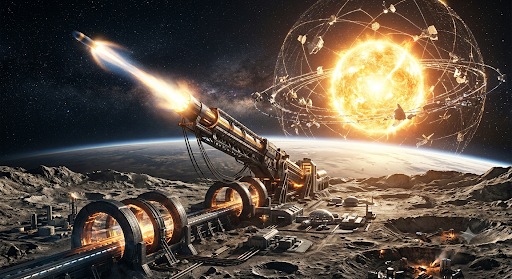
These devices would use magnetic force to push satellites into space. The satellites would be built so they could compact into narrow projectiles and unfold like origami once orbiting the sun.
04 Orbit / the swarm
Presumably, it could take as little as 10 years to surround the sun with a Dyson Swarm - if infrastructure can keep up with production and the surplus of energy (Kurzgesagt. 2018). This would provide civilization with an overwhelming amount of energy in a very short time period, and many wonder what we could use it for. There are unlimited possibilities, but a few in specific tend to peak the interests of researchers. The energy could be used to expand further into space, and Kurzgesagt (2018) believes “it could be the start of interstellar civilization”. For instance, we could direct this energy towards making Mars habitable for humans and therefore a potential option for a home if climate change pushes Earth past the point of return. On the other hand, we could use the energy to keep Earth habitable by making advancements such as highly sustainable infrastructure.
05 More questions than answers
There remain more questions than answers when it comes to bringing the Dyson Swarm to reality, but every modern technology was once a far-fetched idea. Isaac Arthur puts it best: “Why should stars be the silent audience to our story, if they can be the stage upon which we build it?” (Arthur, 2025).